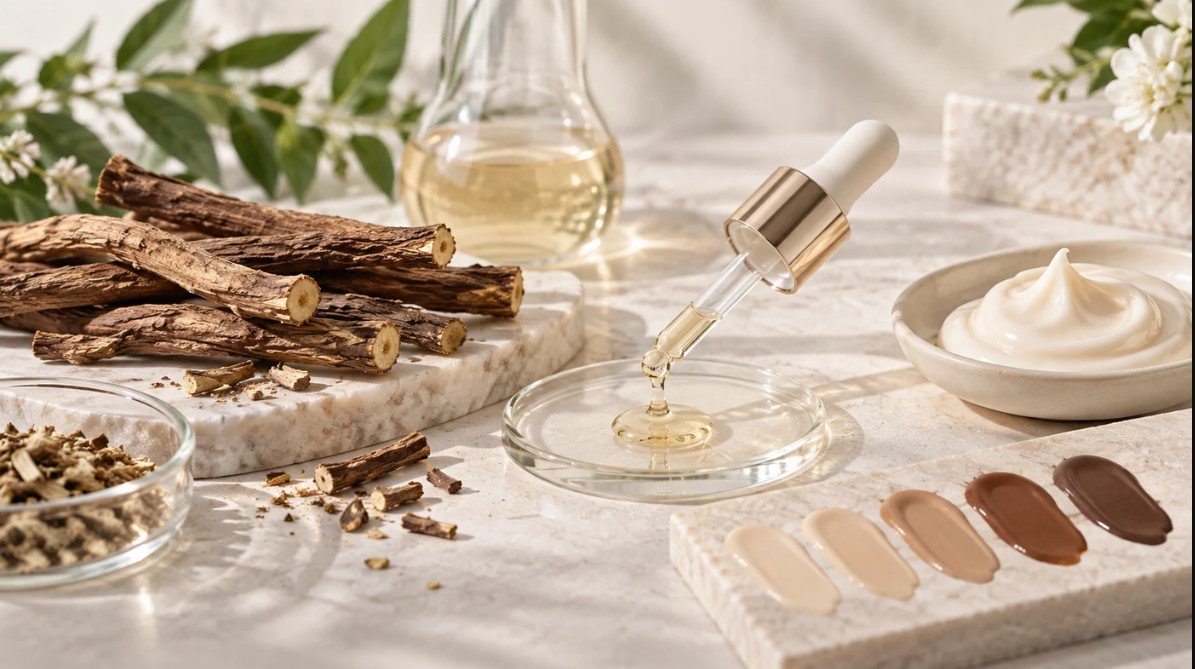
Your new brightening cream just failed the three-month stability test. It turned pale yellow.
You blame the emulsifier. You blame the incubator temperature. You rarely blame your Glabridin suppliers.
But you should.
Most cosmetic formulators treat this licorice root extract like a generic commodity. They download a basic Certificate of Analysis. They look at the price. They buy the powder. Then they wonder why their pristine white emulsion slowly degrades into a muddy mess on the shelf.
It comes down to physical specifications. If you want a stable, high-end skincare product, you cannot dump a low-grade 40% brown extract into your oil phase. You need purity. You need 99%.
We see this exact formulation error every week at glabridin.net.
We don’t just sell the powder. We operate as a direct Glabridin manufacturer. We manage the raw Glycyrrhiza glabra roots. We run the extraction tanks. We know exactly what organic impurities get left behind when suppliers cut corners on the refining process.
Those impurities? They are the exact compounds ruining your cosmetic base.
Let’s look at the actual data. This is the baseline specification you should demand before signing a purchase order. Compare these parameters against your current lab samples.
| Parameter | Specification Limit |
| Botanical Source | Glycyrrhiza glabra (Licorice root) |
| Active Purity Options | 40%, 90%, 98%, 99% |
| Visual Appearance (40%) | Brown to yellow fine powder |
| Visual Appearance (90%-99%) | White to off-white fine powder |
| Solvent Solubility | Soluble in propylene glycol, butylene glycol, squalane |
| Water Solubility | Strictly Insoluble |
| Assay Method | HPLC (High-Performance Liquid Chromatography) |
| Loss on Drying | Less than 5.0% |
| Heavy Metals | Less than 10 ppm |
Notice the visual appearance shift.
A 40% grade carries a distinct brownish-yellow tint. It works fine for a dark-colored herbal serum. But for a premium white cream? It fails instantly. When you step up to 90%, 98%, or our peak 99% purity, the powder shifts to a crisp, clean white. You get total control over the final visual appeal. No artificial color masking required.
Working with this active is strictly an oil-phase game. It repels water completely.
Don’t fight its chemical nature. Pre-dissolve the powder in butylene glycol or ethoxydiglycol. Heat the solvent slightly. Stir it well until completely clear. Then, add it to your main formula during the cool-down phase. Keep your mixing vessel under 40 degrees Celsius.
What happens if your processing temperature spikes? The active molecule breaks down. You lose the brightening efficacy entirely. Your post-production lab tests will come back weak.
This brings us to the reality of the supply chain.
Many procurement teams search blindly for Glabridin suppliers. They grab the first datasheet that looks decent. But what happens when the 5kg bulk drum actually arrives at your loading dock?
The solubility is slightly off. The powder clumps in your solvent tank. The color throws off the entire batch.
This is the exact difference between buying from trading companies and partnering with a real Glabridin manufacturer. Brokers just move boxes. Manufacturers control the chemistry.
Extracting this specific molecule is incredibly difficult. The yield is tiny. It takes massive amounts of raw licorice root to yield a single kilogram of 99% powder. If the extraction temperature is slightly wrong, the active degrades. If the resin filtration is sloppy, you get sticky plant residues.
Quality control has to happen on the factory floor.
We extract, refine, and run the HPLC assays in-house. This isn’t just about putting a pass stamp on a piece of paper. It is about making sure the powder behaves exactly how you expect it to behave in your homogenization tanks.
Let’s talk about shelf life and oxidation.
A badly refined extract degrades fast. The active compound oxidizes when exposed to light, air, and heat. We package our high-purity powder in light-proof, airtight containers. But packaging only does so much.
The real inherent stability comes from removing the organic impurities during extraction.
Those leftover plant impurities act like a catalyst for degradation. When we hit 99% purity, we strip out almost all of those unstable organic tagalongs. The result? A cosmetic powder that holds its potency for a full 24 months.
Think about your production scale.
When you scale up from a 1-liter lab beaker to a 1000-liter manufacturing tank, minor raw material flaws become massive operational headaches. A 1% solubility issue in the lab means wiping a glass beaker. In production, it means clogging your expensive homogenization equipment.
You need a powder that flows well. You need consistent particle size.
We monitor these physical traits just as closely as the chemical assay. Formulators hate clumpy powders. We dry and mill our extracts to ensure a fine, uniform consistency. It disperses into your solvents rapidly. It cuts down your mixing time. It saves your production engineers hours of frustration.
Let’s look at the regulatory side. Cosmetic brands face intense market scrutiny today. Consumers check ingredient lists on their phones. Regulators demand strict safety data.
You need full traceability. You need heavy metal testing that actually means something. Our lab guarantees that lead, arsenic, and mercury levels sit far below international cosmetic limits. We don’t guess. We test every single batch.
We supply brands that sell globally. That means our paperwork holds up to strict regulatory audits in Europe, Asia, and North America.
Are you tired of tweaking your formulas to compensate for raw material variations? Stop doing it. Standardize your inputs.
A high-purity cosmetic active should perform perfectly every single time. It should dissolve cleanly. It should stay stable in the bottle. It should pass microbial testing without a second thought.
Your formulation team has enough problems to solve. Viscosity drops. Fragrance interactions. Emulsion separation.
Sourcing a reliable active ingredient shouldn’t be one of them. Lock down your physical specifications. Talk to your lab team. Match the purity grade directly to your end product.